Art Basel’s (Un)invited Guest: Addressing the AI Question in Fine Art
AI-generated art and artists are legitimate and lucrative (if you base your assessment on just dollar amounts and name brand auction house interest). In a November 2024 Sotheby’s auction, a painting created by an AI robot sold for $1,084,800.[1] In March of 2025, Christie’s auction house closed its first ever AI-only auction, generating $728,784.[2] That March auction was not Christie’s first foray into AI art sales. Back in 2018, an AI-created painting sold for $432,500 at Christie’s.[3] The artists who generated these works with the assistance of AI benefited from both the proceeds and the notoriety from those auctions.
Not all artists rejoiced, however. When the Christie’s all AI auction was announced, a group of artists signed an open letter[4] urging the auction house to cancel the event, claiming that “many” works in the auction “were created using A.I. models that are known to be trained on copyright without a license.” The open letter further condemned the sale as perpetuating “A.I. companies’ mass theft of human artists’ work.”
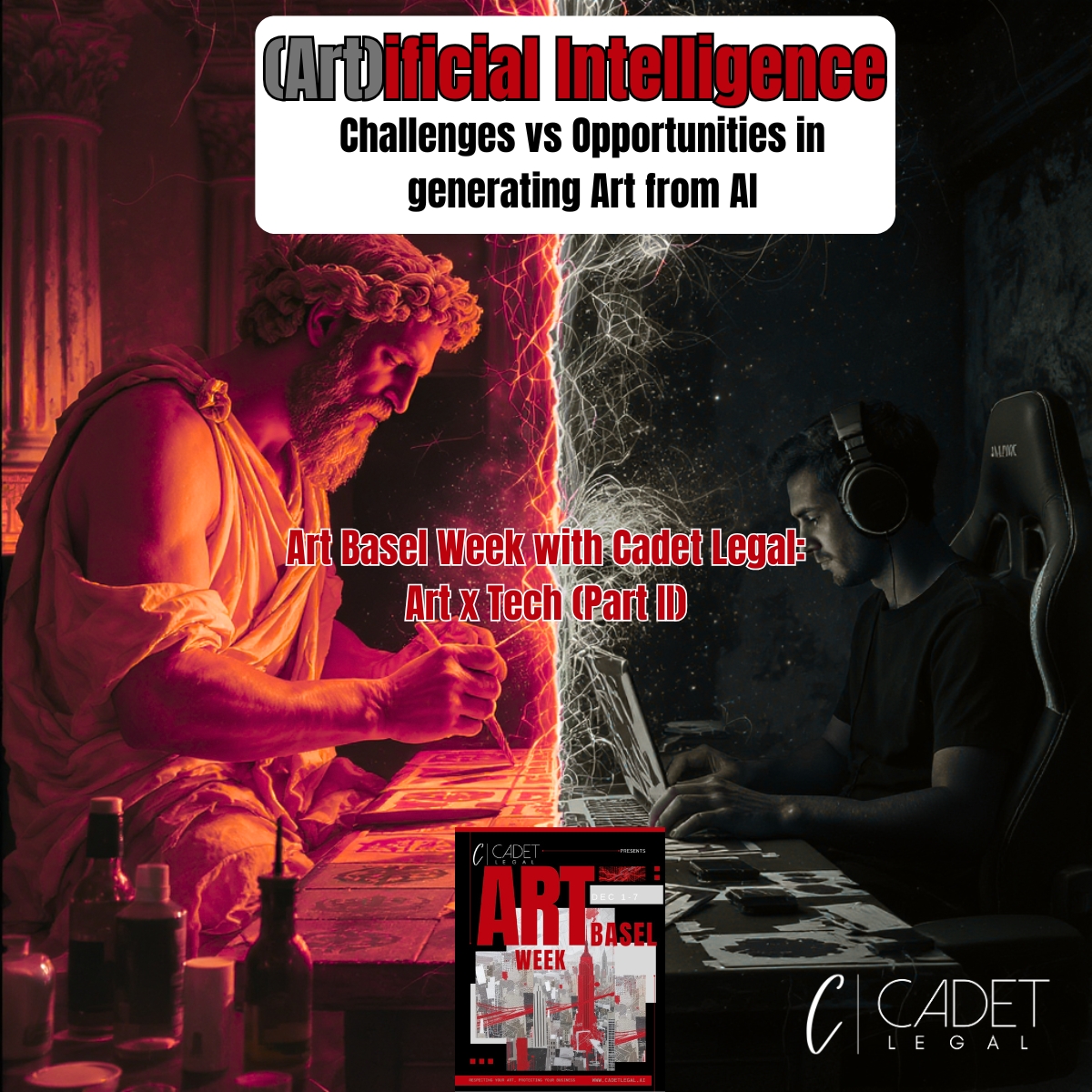
As we (and various galleries and venues) wrap up Art Basel festivities,, -we cannot ignore the giant pink AI elephant in the studio. The art world (like society in general) faces an urgent question: How do we harness AI's potential without losing what makes art meaningful?
By many accounts, the AI art market is expecting continued growth (some estimates suggest as much as 28.9% CAGR over the coming decade).[5] The number of museum spaces and fine art auctions featuring AI-created works continues to grow.[6] Yet for every excited developer of an AI art tool , an artist somewhere questions whether the AI noise will drown out their creative voice.

THE OPPORTUNITY
In an application that artists and technologists alike can appreciate, some art galleries and dealers are embracing AI as a technological tool for verifying provenance and authenticity.
Other, not as uncontroversial potential benefits:
To early AI adopters and evangelists, AI also serves to democratize artistic tools, allowing creators without formal training to bring visions to life.
Many digital creators already use AI tools in their work. We have represented multiple genAI startups by founders focused on creative visuals (including AI for film, children’s stories, and interior design). When thoughtfully integrated, AI can become a collaborative partner, accelerating visualization, exploring style variations, and augmenting human intuition rather than replacing it. Artists like Claire Silver (who used AI to create an NFT titled, daughter), Refik Anadol, and duo Holly Herndon and Mat Dryhurst demonstrate that AI can expand reach and enable entirely new artistic forms. For commercial creators in design and marketing (including within our consumer-facing clients), AI has proven to increase efficiency.
THE OBSTACLES
The challenges also deserve serious attention. Copyright concerns loom largest: (i) infringement (many AI models are trained on artists' works without consent, extracting creative value without compensating them) and (ii) authorship (at what point does AI involvement in the creative process negate human authorship and thus copyright).
Infringement: We first wrote about the intellectual property risk of AI inputs back in 2023. That risk has only grown, particularly in the art context. Imagine that you are an artist, and you Google your own name. What you increasingly would find is AI art instead of your original pieces, which are being buried by algorithms that increasingly favor AI-generated content.
Recent court decisions may encourage more artists to act. For example, a California judge allowed a 2024 lawsuit by various artists against Midjourney, DeviantArt and other AI art platforms to move forward on copyright infringement claims.[7]
Authorship: Beyond infringement, the question of authorship itself proves difficult. Most artists believe that their contribution remains fundamental when creating AI-assisted work. But as AI capabilities improve, where does human creativity end and algorithmic pattern-matching begin? The answer to this question has practical impact - who profits (and how) when AI models commodify the creative process? The D.C. Circuit Court in Thaler v. Perlmutter served as a recent definitive statement that works created autonomously by AI without human intervention cannot receive copyright protection (No. 23-5233 (D.C. Cir. 2025)). So we understand that some human involvement is necessary, but the question of how much remains.
Beyond authorship, concerns over bias also emerge. To the extent that training data skews toward Western aesthetics, this may perpetuate cultural bias and marginalize minority voices in an industry already dealing with questions of representation.
WHAT’S NEXT?
We see the path forward as developing synergies between AI and human creativity rather than pitting them against each other.
Recent moves by some collectors and galleries signal the opportunity (and demand) for Human x AI collaboration. Their AI auctions are promoting and compensating the artists who leverage AI intentionally without replacing human decision-making entirely. While celebrating these AI-enabled artists, we cannot forget the rights of those who choose not to use this technology.
My IP-focused colleagues and I have been calling on policymakers would establish clear copyright protections while preserving innovation.
Artists need transparent, ethical AI training practices using consented and paid or public-domain datasets (Adobe's approach offers one example ). Institutions (and AI platforms) can (and are starting to) invest in AI literacy programs to help creators understand the tools rather than fear them.
Art Basel week reminds us why this discussion matters. Art isn't about efficiency, but rather meaning, perspective, emotion, and the irreplaceable human experience. The best outcome isn't a future where AI replaces artists or where humans ignore AI's potential. It's one where AI remains a tool in service of human vision, not a replacement for it.
The conversation is only beginning. Art institutions, legal experts, and creators have an opportunity to shape this moment together. If you have questions or concerns, we would love to talk.
Disclaimer. The contents of this article should not be construed as legal advice or a legal opinion on any specific facts or circumstances or investment or fundraising advice. Your viewing and/or use of the contents of this article do not create an attorney-client relationship with Cadet Legal. The contents are intended for general informational purposes only, and you are urged to consult with counsel concerning your situation and specific legal questions you may have.
[1] https://www.bbc.com/news/articles/cpqdvz4w45wo
[2] https://press.christies.com/augmented-intelligence-totals-728784
[3] https://www.christies.com/en/stories/a-collaboration-between-two-artists-one-human-one-a-machine-0cd01f4e232f4279a525a446d60d4cd1
[4] https://openletter.earth/cancel-the-christies-ai-art-auction-f5135435?limit=0
[5] https://market.us/report/ai-in-art-market/
[6] Hiscox, ART AND AI REPORT 2024: What is the future for producing and collecting AI-generated art?, https://www.hiscoxgroup.com/sites/group/files/documents/2024-09/Art%20and%20AI%20Report%20September%202024.pdf
[7] https://www.hollywoodreporter.com/business/business-news/artists-score-major-win-copyright-case-against-ai-art-generators-1235973601/